

 Home
Home About Us
 Ag Library
 Ag Tech
 Ag Funding
 Ag Events
 Ag Directory
 Ag News
 Ag Innovation
 Contact Us
Ag Marketing Shifts as AI Moves From Pilot to Daily Farm Operations
AI in agriculture is moving from experimentation toward operations, with 17% of global farmers already using generative AI for farm-related tasks, according to McKinsey & Company. The bigger commercial challenge is converting curiosity into paid, trusted, repeatable workflows. Farmers are testing AI for planning, crop management, research, and other information-heavy tasks while still relying on human expertise for important decisions. That gap creates a clear opening for better agricultural marketing, stronger positioning, and measurable value.
Key Statistics on AI in Agriculture: From Pilot to Operations
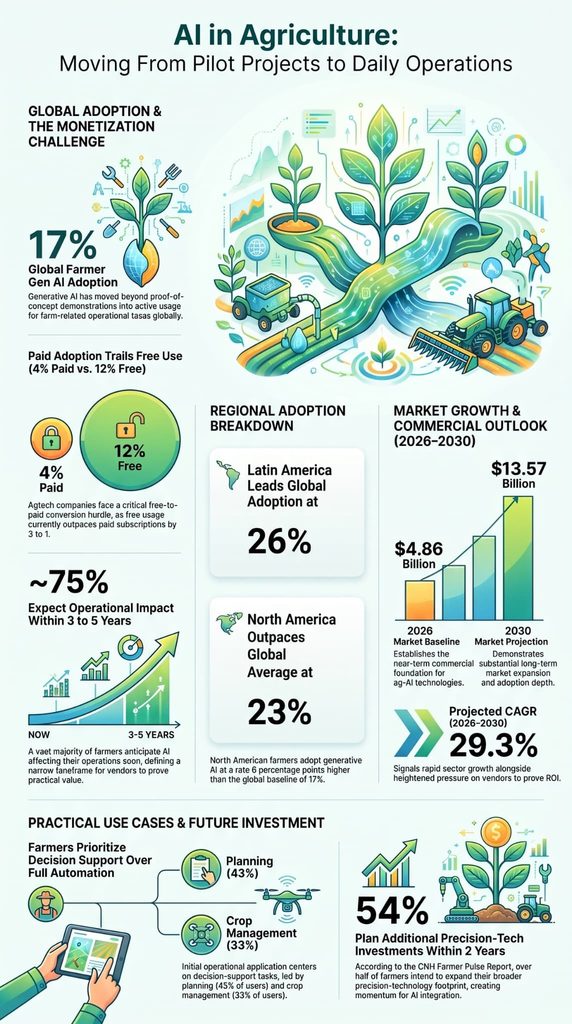
The statistics show a widening gap between experimentation, payment, regional adoption, expected impact, and operational investment.
- 17% – Global farmers using generative AI for farm-related tasks, showing that agricultural AI has already moved beyond isolated demonstrations.
- 4% paid (12% use free versions) – Paid adoption trails experimentation, pointing to a major free-to-paid conversion challenge for agtech companies.
- 26% adoption – Latin America records the highest reported Gen AI adoption in the supplied data, making regional market segmentation essential.
- ~75% – Farmers expecting AI to affect operations within three to five years, suggesting a relatively short window for vendors to establish operational relevance.
- $4.86 billion – The reported 2026 AI in agriculture market size, providing a commercial baseline for agricultural technology growth.
- $13.57 billion – The projected 2030 market size, indicating substantial expected expansion in AI-enabled agriculture.
- 29.3% – The projected 2026–2030 CAGR, signaling rapid market growth but also stronger pressure to demonstrate ROI.
- 43% planning, 33% crop management – Practical use cases show that farmers are applying Gen AI to decision-support tasks before full automation.
- 23% – North American farmers using Gen AI, placing the region above the supplied global adoption figure.
- 54% of farmers – Farmers planning additional precision-technology investment within two years, according to the CNH Farmer Pulse Report.
The McKinsey survey confirms that Gen AI is already being used for farm-related tasks and that adoption is highest in Latin America and North America. The same research also shows that farmers remain selective about spending and continue to demand demonstrable returns.
Why Are 17% Of Farmers Using Generative AI For Farm-Related Tasks?
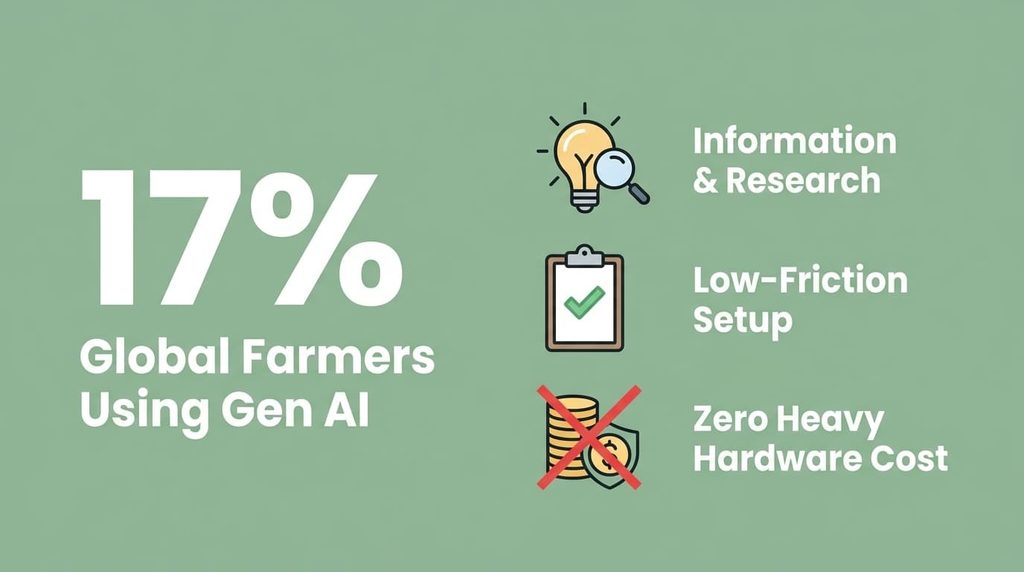
The 17% adoption rate shows that generative AI has moved into practical farmer experimentation rather than remaining a technology-industry concept.
Generative AI has a lower entry barrier than tractors, sensors, robotics, or other hardware-dependent agtech. A farmer can test an AI assistant without installing equipment or rebuilding a farm’s technology stack.
McKinsey & Company reported that 17% of surveyed farmers already use Gen AI for farm-related tasks. The 2026 Global Farmer Insights survey also notes that Gen AI has broader applications and is easier to adopt than hardware-based technologies.
- Farmers can use AI for research and information gathering.
- Agribusiness teams can apply it to planning and communication.
- Producers can test tools without major capital expenditure.
- Marketers can reach users earlier through agricultural digital marketing.
That low-friction entry point changes farm marketing. Agricultural website optimization, farm SEO, agriculture content marketing, and agricultural video marketing can now support an audience that is actively learning about AI before buying it.
Why Do Only 4% Of Farmers Pay For AI Tools While 12% Use Free Versions?
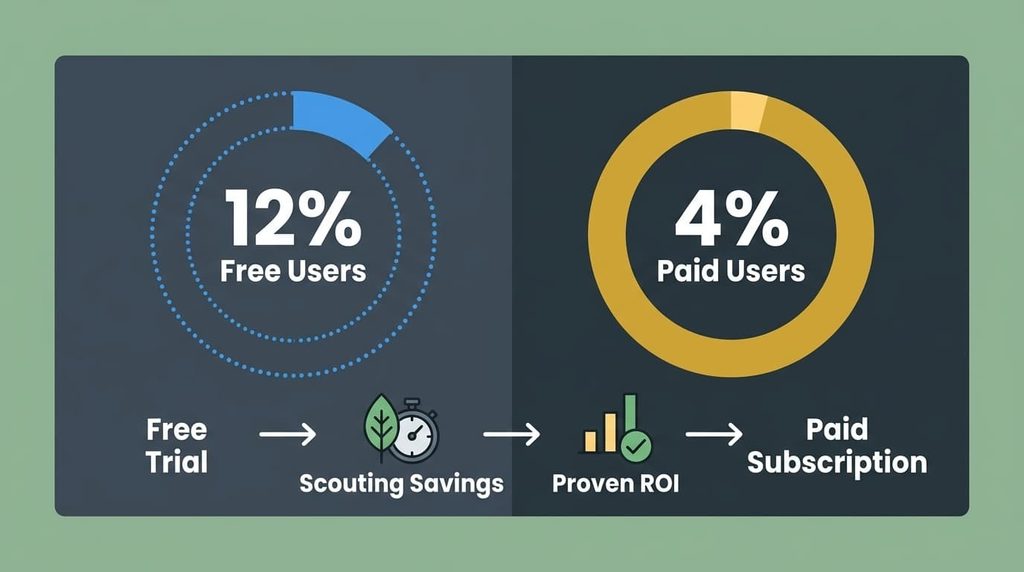
The 4% paid rate suggests farmers want to validate value before committing scarce operating capital to AI products.
McKinsey & Company found that 4% of farmers surveyed pay for Gen AI solutions, while the supplied data separates a larger group using free versions. The difference illustrates a classic agricultural sales funnel problem: awareness is easier to generate than conversion.
Farmers operate around seasonal budgets, uncertain commodity prices, weather exposure, input costs, and labor constraints. A software subscription therefore competes against every other expense on the farm.
The strongest ag marketing strategies should make the economic case visible before asking for a purchase.
- Show one measurable farm problem.
- Explain the expected operational improvement.
- Demonstrate how quickly value can appear.
- Provide a clear path from free trial to paid use.
This is where agricultural value proposition design matters. A product described as “AI-powered” may attract attention, but a product positioned around fewer scouting hours, faster planning, lower waste, or better crop decisions gives buyers something concrete to evaluate.
Why Does Latin America Lead Global Gen AI Adoption At 26%?
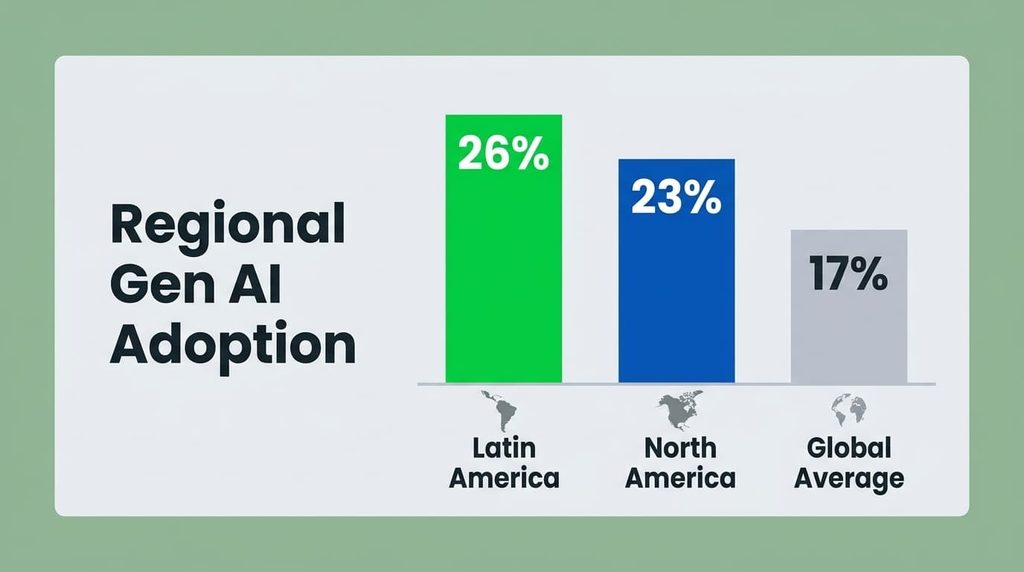
Latin America’s 26% adoption rate suggests agricultural AI uptake depends heavily on regional conditions, market structures, and local technology behavior.
The supplied McKinsey data places Latin America at 26%, above the global 17% figure and the reported North American 23% figure. McKinsey’s 2026 research also identifies Latin America and North America as the regions with the highest Gen AI adoption.
| Region | Gen AI adoption | Strategic implication |
| Latin America | 26% | Strong early-adoption opportunity |
| North America | 23% | Established but expanding adoption |
| Global | 17% | Significant room for growth |
Regional variation matters for agricultural market segmentation. Agribusiness marketing campaigns should account for crop types, farm size, connectivity, language, advisory systems, and purchasing power rather than treating farmers as one audience.
That creates room for farm niche marketing, agricultural target audience research, farm buyer personas, and localized agricultural content strategy.
Why do about 75% of farmers expect AI to impact operations within 3-5 years?
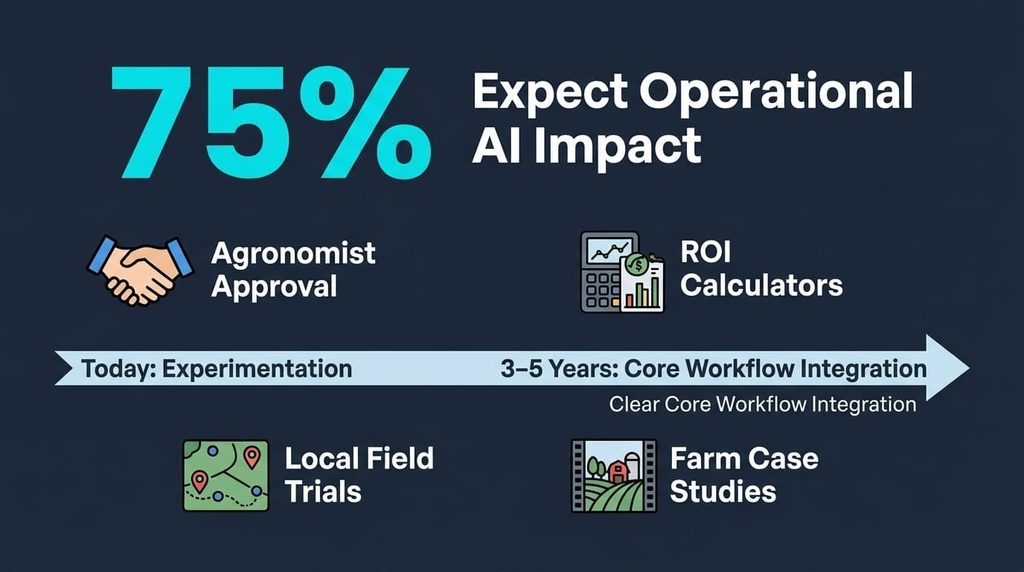
The approximately 75% expectation suggests farmers increasingly view AI as an operational technology rather than a temporary experiment.
Expectation and adoption are different measures. A farmer can believe AI will affect operations within three to five years without currently paying for an AI product.
Still, the expectation creates urgency for vendors. Agricultural companies have a limited period to establish trusted workflows, prove performance, and build customer retention before competitors occupy those positions.
McKinsey’s research shows that farmers remain open to innovation but are becoming more disciplined about spending. They increasingly favor technologies that solve specific farm problems, fit existing workflows, and demonstrate value under local conditions.
For agricultural marketing, this means campaigns should focus less on futuristic claims and more on adoption readiness. Farm case studies, agricultural testimonial marketing, webinars, demonstrations, and ROI calculators can reduce uncertainty before purchase.
How Could The AI In Agriculture Market Grow From $4.86 Billion In 2026?
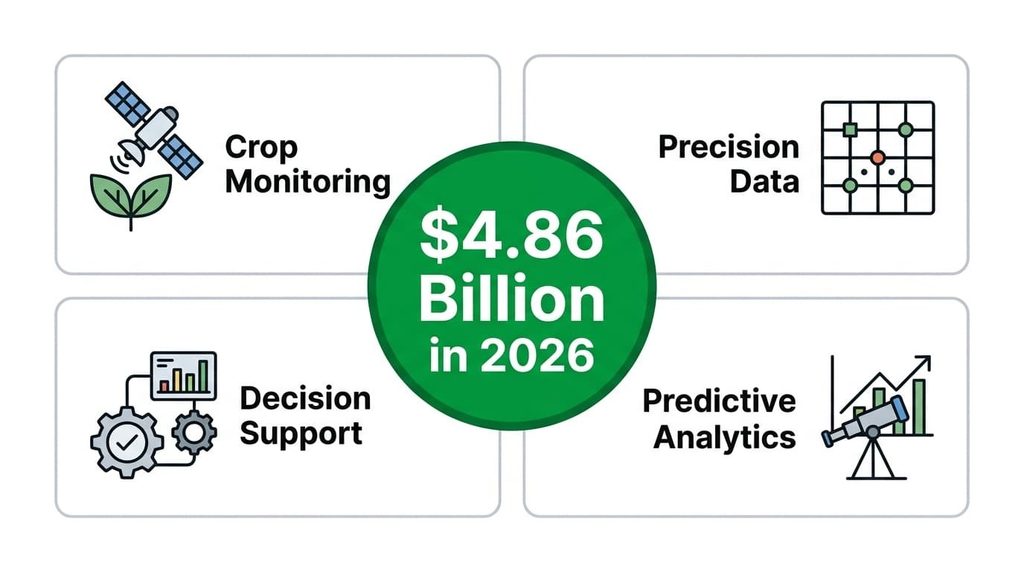
A $4.86 billion 2026 market estimate provides a baseline for the expanding commercial opportunity around agricultural AI.
Research and Markets, using data from The Business Research Company, reports an applied AI in agriculture market size of $4.86 billion in 2026. The market drivers include crop monitoring, automation, agricultural data generation, precision farming, and reduced dependence on manual labor.
That growth creates opportunities across decision support, farm management, crop monitoring, livestock technology, autonomous equipment, and predictive analytics.
For agribusiness marketing teams, market expansion means more competitors will need clearer positioning. Agricultural competitive analysis becomes more important when multiple vendors offer similar AI capabilities.
- Decision-support platforms can target planning problems.
- Precision tools can connect AI with field data.
- Livestock systems can focus on monitoring and alerts.
- Agribusiness promotion can emphasize measurable operational outcomes.
Of course, market size does not equal farmer revenue. The commercial winners still need agricultural ROI tracking, farm marketing metrics, and strong agricultural customer retention.
Why Could The AI In Agriculture Market Reach $13.57 Billion By 2030?
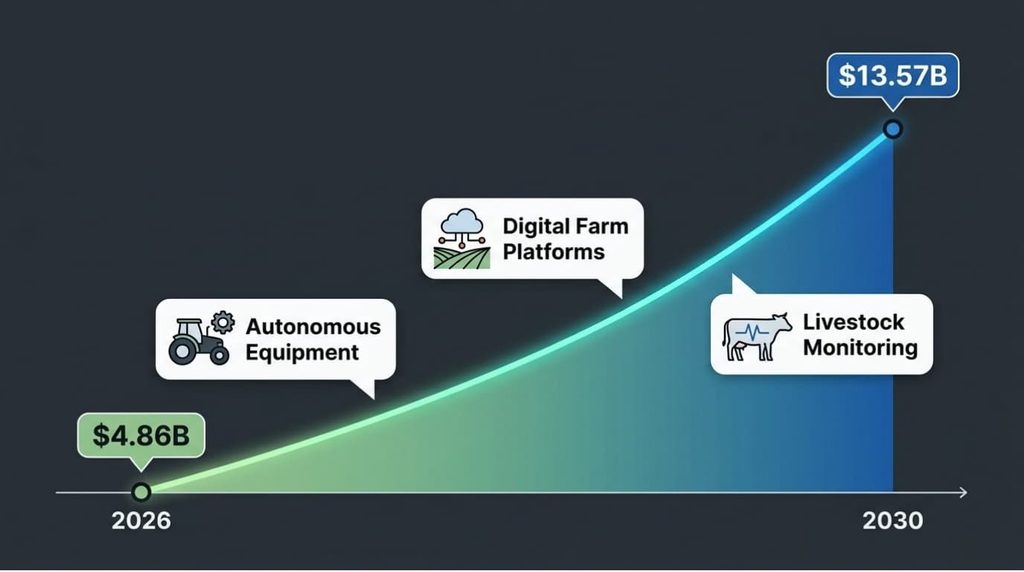
The $13.57 billion 2030 forecast signals substantial expected commercial expansion if AI adoption converts into recurring operational value.
Research and Markets reports that the applied AI in agriculture market could reach $13.57 billion by 2030. Its forecast points to predictive analytics, autonomous agricultural machinery, digital farm platforms, livestock monitoring, and AI-supported productivity as major growth areas.
The distance between $4.86 billion in 2026 and $13.57 billion in 2030 matters for marketers because it implies a market moving from early adoption toward broader commercialization.
A growing market also raises customer expectations. Agricultural buyers will compare vendors more carefully, making agricultural positioning strategy and ag unique selling proposition work increasingly important.
That said, projected market growth should not be treated as proof that every AI product will succeed. Farmers still control the final purchase decision, and their willingness to pay depends on local economics, usability, trust, and demonstrated results.
What Does A 29.3% CAGR Mean For Agricultural AI Vendors?
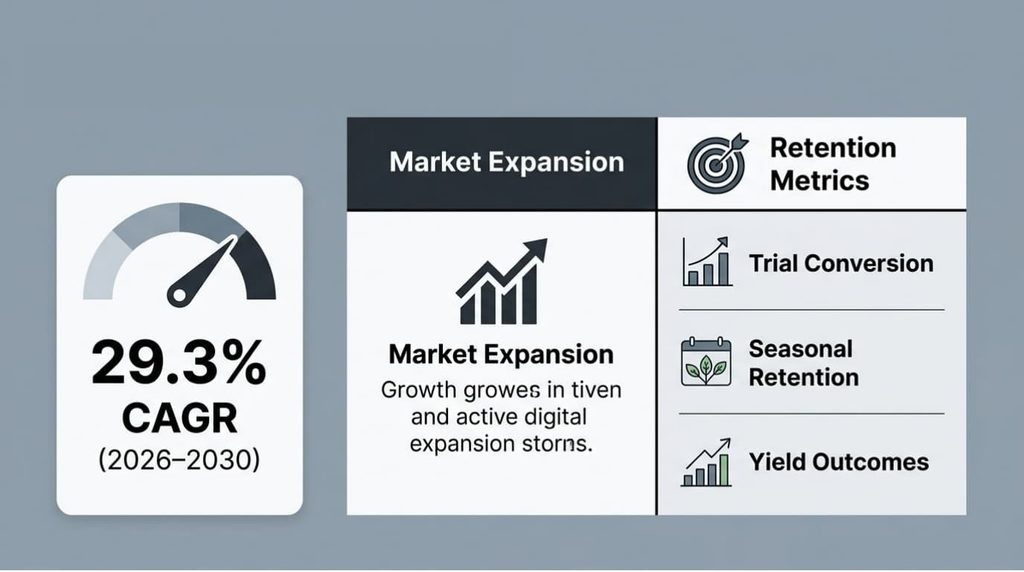
A 29.3% CAGR represents rapid projected market expansion and stronger pressure for AI vendors to turn pilots into scalable products.
Research and Markets lists a 29.3% compound annual growth rate for the 2026–2030 forecast period. At that pace, the market could expand quickly enough to attract new software companies, equipment manufacturers, data providers, and established agribusinesses.
For vendors, fast growth creates two simultaneous pressures. They must capture demand while also proving that their systems work beyond controlled pilots.
This affects agricultural lead generation and ag conversion optimization. A landing page that lists model accuracy may not be enough. Buyers increasingly need proof tied to farm economics, workflow integration, and production outcomes.
Agricultural market research should therefore track more than clicks and leads. Strong farm marketing metrics include trial-to-paid conversion, seasonal retention, usage frequency, operational savings, yield-related outcomes, and customer lifetime value.
Why Are 43% Of Farmers Using Gen AI For Planning And 33% For Crop Management?
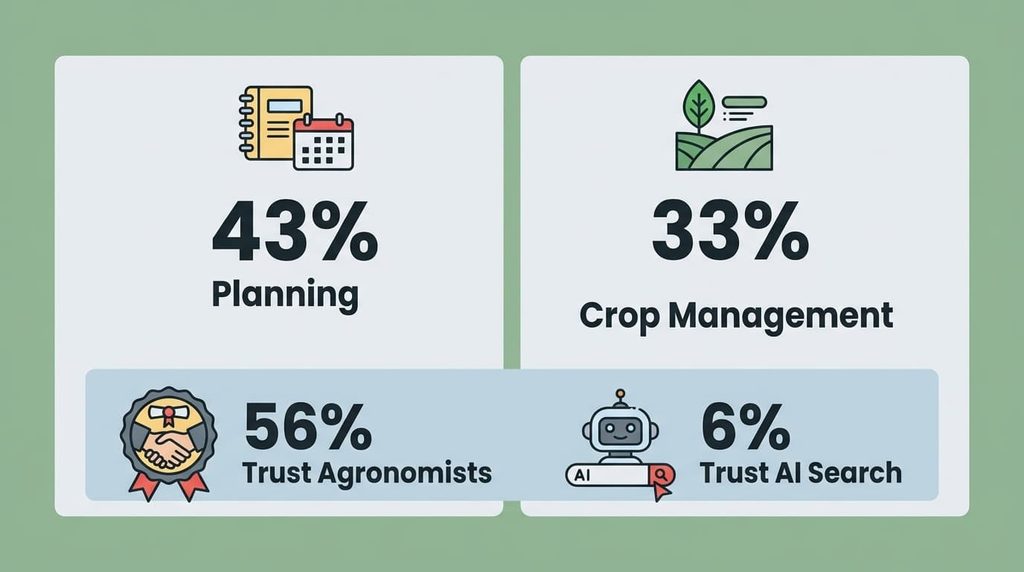
Planning and crop management are leading Gen AI use cases because they involve information-heavy decisions where AI can assist without fully replacing human judgment.
The supplied McKinsey figures show 43% use Gen AI for planning and 33% for crop management. These applications fit the current strengths of generative tools: organizing information, producing recommendations, comparing options, summarizing material, and supporting decision preparation.
The distinction between assistance and automation matters. A farmer can use AI to structure a crop management decision while still asking an agronomist to validate the recommendation.
McKinsey reports that 56% of farmers cite agronomists as a trusted influence, while only 6% cite Gen AI tools or AI search as a trusted decision-making source.
That trust hierarchy changes agricultural content marketing. AI vendors can strengthen credibility through expert commentary, farm case studies, agronomic validation, agricultural thought leadership, and agricultural media relations.
The opportunity is not to replace expertise. It is to make expert-backed decisions faster and easier to act on.
Why Are 23% Of North American Farmers Using Gen AI?
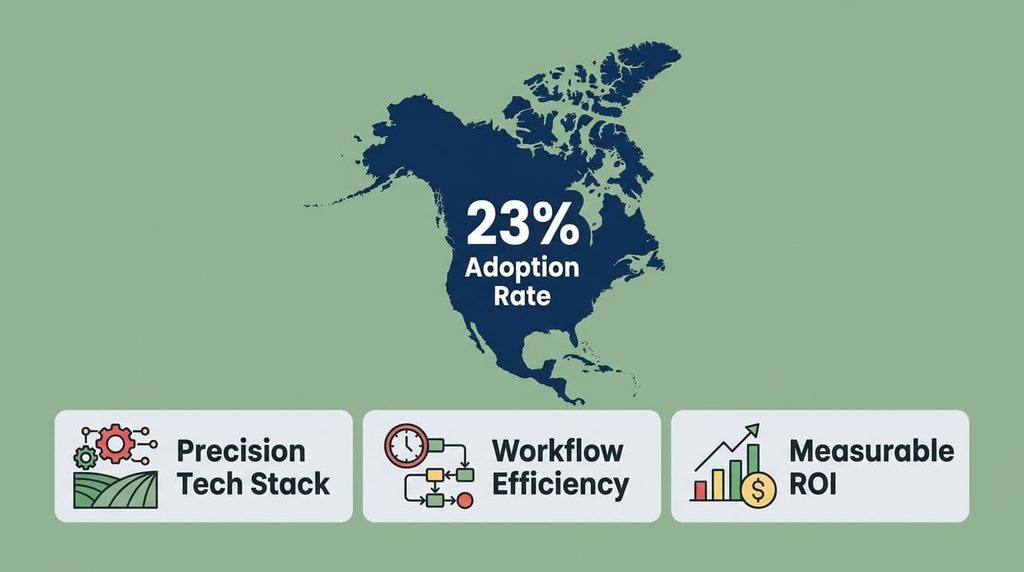
The 23% North American adoption rate shows meaningful regional penetration while leaving considerable room for additional adoption.
The supplied data places North American farmer Gen AI adoption at 23%, six percentage points above the global 17% figure.
McKinsey’s 2026 survey confirms that North America is among the regions with the highest Gen AI adoption. Its broader findings also show that farmers remain selective with spending and expect clear returns from new technology.
For marketers, the regional gap can support differentiated agricultural advertising. A campaign aimed at North American producers may emphasize integration, precision technology, workflow efficiency, and measurable ROI.
Why Do 54% Of Farmers Plan Precision Technology Investment Within Two Years?
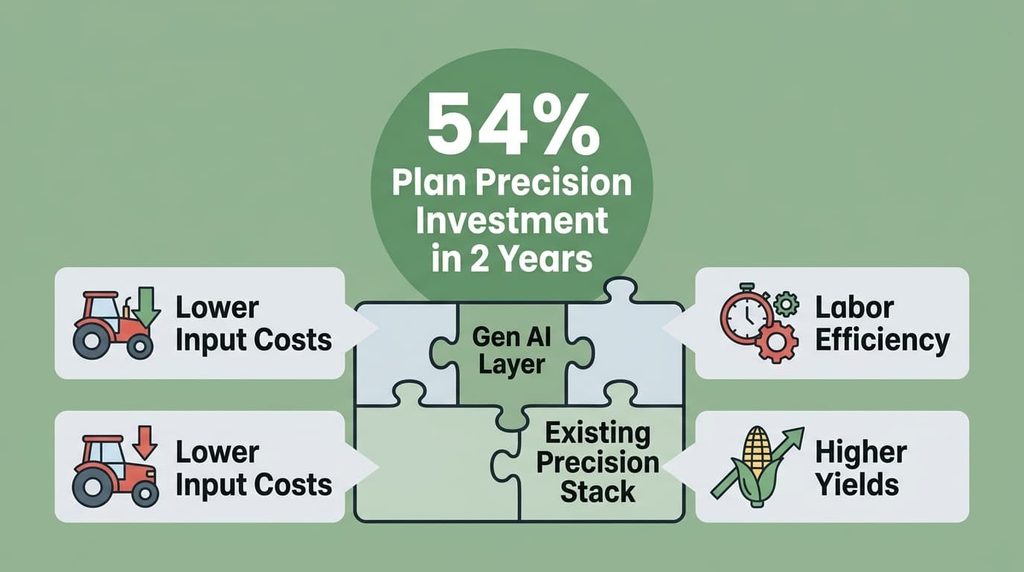
The 54% investment intention suggests that precision agriculture is creating an existing technology pathway into broader AI adoption.
The CNH Farmer Pulse Report, based on 217 farmers and ranchers surveyed in the United States and Canada, found that 54% planned to invest in additional precision technology within two years. CNH also reported that farmers cited lower input costs, greater labor efficiency, and higher yields among the main reasons for adoption.
The implication is useful for agricultural marketers. AI does not need to be sold as a completely separate technology category.
It can be positioned as part of an existing precision-agriculture stack.
- Connect AI with existing farm data.
- Explain how it improves a familiar workflow.
- Show how it supports efficiency or cost control.
- Demonstrate compatibility with established systems.
This supports farm marketing plans that connect agricultural digital marketing with equipment, agronomy, data, and advisory services. It also creates opportunities for agricultural partnerships, agricultural co-op marketing, and agribusiness promotion.
How Can Ag Marketers Move Farmers Beyond The AI Pilot Trap?
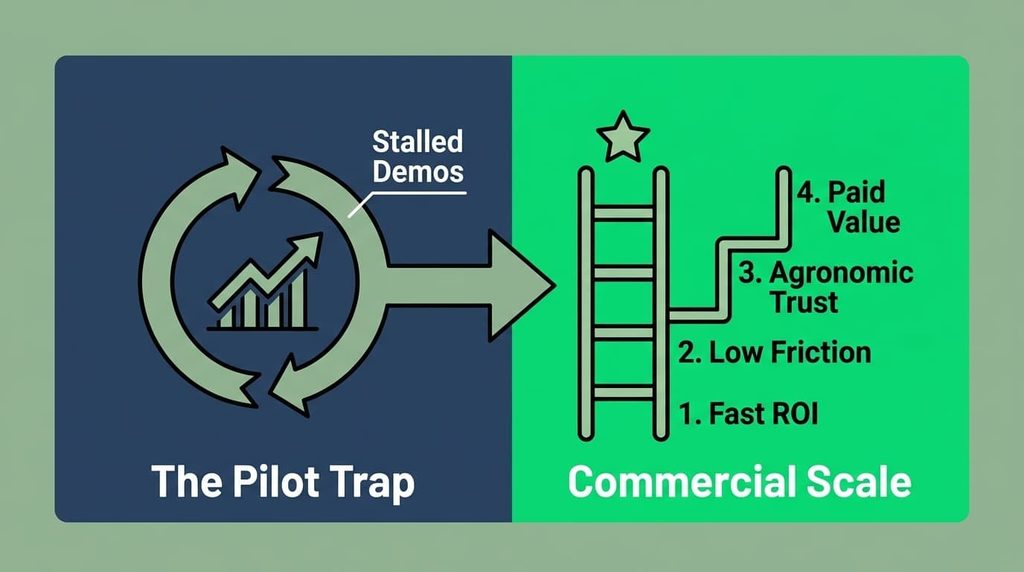
The strongest opportunity is to make AI prove measurable value within a farming season rather than asking farmers to fund an indefinite data strategy.
The World Economic Forum describes agriculture’s “pilot trap” as a problem where technologies perform well in demonstrations but stall under commercial conditions. The organization points to tight unit economics, variable biology, fragmented operations, and workflow complexity as barriers to scale.
The issue is therefore larger than model performance. A highly accurate system can still fail if workers cannot use it easily, data arrives too late, or the farm cannot see a financial benefit.
- Prove ROI quickly: Connect product features with measurable farm outcomes.
- Reduce workflow friction: Fit the product into processes farmers already understand.
- Build trust: Position AI as decision support rather than a replacement for agronomic expertise.
- Start with practical use cases: Planning and crop management already show meaningful adoption.
- Convert free users: Create a clear bridge from experimentation to paid value.
- Measure seasonally: Use outcomes that farmers can evaluate during a production cycle.
For agricultural marketing, this changes the message from “advanced AI technology” to “a tool that helps solve a defined farm problem.” Farm buyer personas, agricultural customer retention, ag CRM systems, and agricultural ROI tracking should all reflect that shift.
What Does The Gap Between AI Experimentation And Payment Mean For Farmtable?
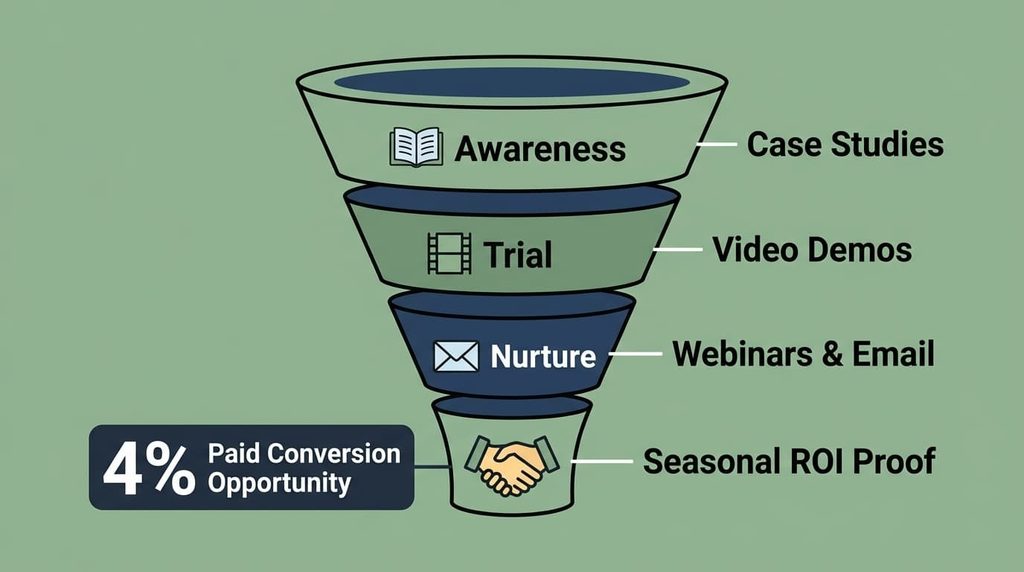
FarmTable can frame agricultural AI around practical outcomes, seasonal ROI, and operational adoption rather than technology novelty.
The 4% paid adoption figure creates a useful positioning challenge. Farmers are willing to experiment, but many still need stronger evidence before allocating a budget.
FarmTable can address that gap through a value-led agricultural sales funnel. The first interaction can educate. The next can be demonstrated. The final step can prove value through a measurable operational result.
That approach also fits broader agricultural marketing practices:
- Use agriculture content marketing to explain practical problems.
- Use agricultural video marketing to demonstrate workflows.
- Use farm case studies to establish credibility.
- Use ag webinar marketing for deeper education.
- Use agricultural email marketing to nurture trial users.
- Use agricultural testimonial marketing to reduce purchase uncertainty.
The goal is not to make AI sound more sophisticated. It is to make the financial and operational reason for using it easier to understand.
Of course, FarmTable-specific performance data was not supplied in the source material, so claims about conversion rates, revenue, or customer outcomes should not be invented. The positioning opportunity is supported by the wider farmer adoption data and the documented need for clear ROI.
FAQ
How can I build an agricultural marketing plan that reaches the right buyers?
Start with agricultural market research to define your agricultural target audience and farm buyer personas. Then choose practical ag marketing strategies, set a clear agricultural value proposition, and create a realistic ag marketing calendar. Include farm marketing metrics and agricultural ROI tracking so you can see which campaigns generate qualified leads, sales, and repeat customers over time and across channels.
Which digital channels should I use for farm marketing and agribusiness marketing?
Use agricultural digital marketing channels based on where your buyers spend time. Farm SEO and agricultural website optimization can capture search demand, while agricultural social media marketing, agricultural email marketing, and farm YouTube marketing can build trust.
For faster reach, consider ag PPC campaigns, agricultural video marketing, and agricultural lead generation through useful landing pages and lead magnets for buyers.
How can I make my farm branding and agricultural branding more memorable?
Build farm branding strategies around a clear agricultural value proposition and ag unique selling proposition. Use consistent messages, visuals, and proof across your website, social channels, email, and sales materials.
Farm case studies, agricultural testimonial marketing, and agricultural thought leadership can strengthen trust. Your agricultural positioning strategy should also reflect your farm niche marketing and customer priorities clearly and consistently.
How do I measure whether my agricultural marketing campaigns are actually working?
Track agricultural analytics that connect activity with business results. Useful farm marketing metrics include website traffic, qualified leads, conversion rates, customer retention, and revenue. Compare ag campaign performance across channels, then review agricultural ROI tracking regularly.
Agricultural market segmentation and ag competitive analysis can help explain why certain audiences, offers, or seasonal campaigns perform better than others consistently across campaigns.
What should I include in a farm marketing plan before launching a seasonal campaign?
Set goals, identify your agricultural target audience, and map each stage of the agricultural sales funnel. Include crop marketing plans, livestock marketing, farm direct marketing, and farm-to-consumer marketing where relevant.
Plan agricultural advertising, agricultural seasonal campaigns, agricultural email marketing, and agricultural community engagement in advance. Finish with budget allocation, deadlines, responsibilities, and clear measures of campaign success, follow-up, and review.
What Should Agricultural AI Companies Do Next?
Agricultural AI companies need to prove that their tools solve real problems before expecting farmers to pay for them. Adoption depends on trust, measurable results, and whether the technology fits existing farm workflows. A successful pilot should lead to a repeatable process, not remain a one-off demonstration.
The next step is connecting AI with a clear path from interest to adoption. Explore FarmTable’s Agricultural Marketing Services can help turn useful technology into clearer market positioning and demand. Learn More About FarmTable The goal is simple, show value farmers can understand and measure.