

 Home
 About Us
 Ag Library
 Ag Tech
 Ag Funding
 Ag Events
 Ag Directory
 Ag News
 Ag Innovation
 Contact Us
Local SEO for Rural and Regional Businesses Shifts as Review Recency Beats Volume
Local SEO for rural and regional businesses is changing as review freshness, customer trust, and AI-powered discovery gain attention. Whitespark’s 2026 Local Search Ranking Factors survey scored review recency at 164, compared with 170 for review quantity and 154 for a sustained influx of reviews.
These scores suggest that rural businesses should build a steady flow of genuine customer feedback rather than focus only on total review counts. The findings also point to changing discovery habits across Australia. Here is how businesses can use this data to improve local search visibility.
Key Statistics on Review Recency and Local Search Rankings
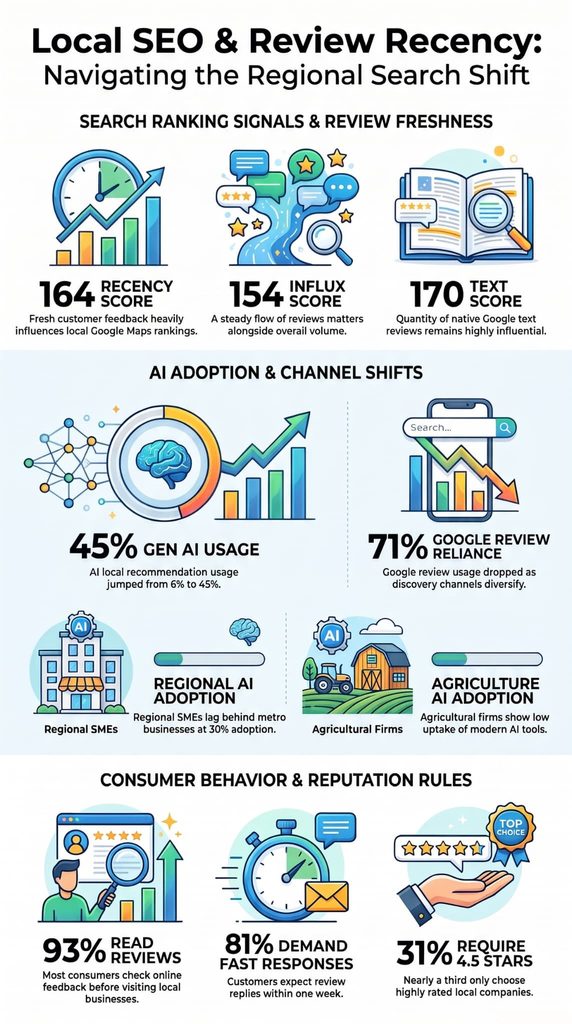
The following 10 statistics show how review signals, consumer expectations, and AI adoption relate to local search visibility. They come from the supplied data pack and its named research sources. The findings should be interpreted within each source’s methodology and survey sample.
- 164 – Whitespark’s score for review recency places fresh customer feedback among the influential factors in local pack and Google Maps rankings.
- 154 – The sustained influx of reviews score suggests that a steady flow of feedback matters alongside the total review count.
- 170 – The score for the quantity of native Google reviews with text shows that review volume remains a significant local ranking consideration.
- 45%, up from 6% – Reported use of generative AI for local business recommendations rose sharply between 2025 and 2026, signalling a shift in how consumers find businesses.
- 71%, down from 83% – Reported Google review usage declined year over year, suggesting that consumers are exploring additional discovery channels.
- 16% regional vs. 30% metro – Regional Australian SMEs report lower AI adoption than metropolitan businesses, creating a gap between the regions and major cities.
- Fewer than 30% – The supplied data pack reports low AI adoption among agriculture businesses, suggesting that many agricultural firms have yet to adopt these tools.
- 93% – The supplied statistic indicates that most consumers read online reviews before visiting a local business, making reputation management important.
- 81% – The reported share of consumers who expect a response to reviews within a week highlights the need for timely customer engagement.
- 31% – The reported share of consumers who only use businesses rated at least 4.5 stars shows how ratings can affect customer choices.
How Does a Review Recency Score of 164 Compare With Other Ranking Factors?
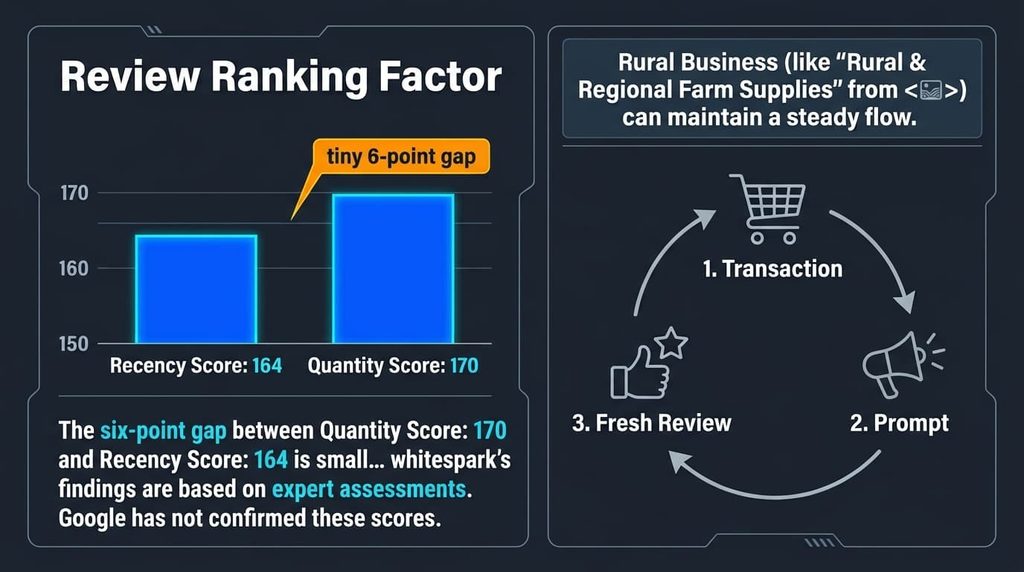
Whitespark’s 2026 survey places review recency close to review quantity and sustained review growth in its local pack and Maps rankings. These three scores suggest that local businesses should manage their review profiles as an ongoing activity.
| Review ranking factor | Score | What it means for rural businesses |
| Quantity of native Google reviews with text | 170 | Build a credible review history over time. |
| Recency of reviews | 164 | Encourage genuine feedback from recent customers. |
| Sustained influx of reviews | 154 | Develop a consistent review collection process. |
The six-point gap between quantity and recency is small. However, the scores do not prove that Google treats these factors as interchangeable or that a business with fewer reviews will rank higher because its reviews are newer.
Whitespark’s findings are based on expert assessments. Google has not confirmed these scores as its ranking formula.
For rural businesses, the practical response is to build review volume while keeping feedback current. A regional agricultural supplier, for example, can request reviews after equipment sales, deliveries, repairs, or completed advisory projects.
Why Is the Six-Point Difference Important?
A small difference between expert-weighted scores suggests that businesses should avoid focusing on a single review metric.
A balanced review generation strategy should include:
- Requesting honest feedback after completed transactions.
- Maintaining a steady flow of reviews throughout the year.
- Responding to positive and negative feedback.
- Tracking review volume, recency, and recurring customer concerns.
Businesses should never buy reviews, fabricate customer experiences, or offer rewards in exchange for positive ratings. The goal is to build a trustworthy reputation that reflects actual customer experiences.
Why Does a Sustained Review Influx Score 154?
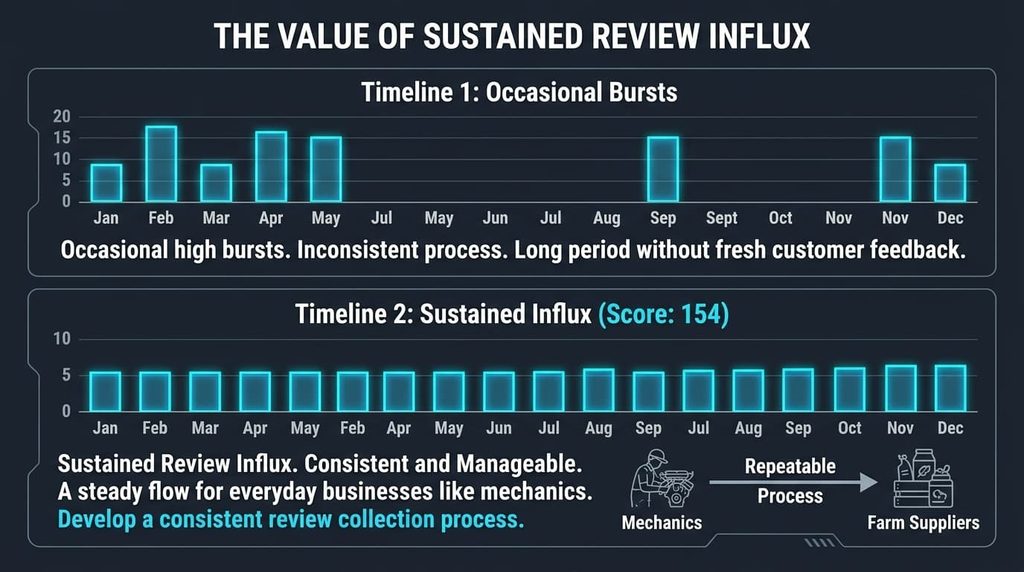
The sustained influx score of 154 suggests that experts value a consistent flow of reviews rather than occasional bursts of feedback.
For small town businesses, this approach offers a manageable alternative to large review campaigns. A rural mechanic, farm equipment supplier, or agricultural contractor can build a repeatable process around completed jobs and customer follow-ups.
The underlying idea is straightforward. A business that requests feedback consistently can maintain a more current review profile than one that only asks customers during an occasional marketing campaign.
How Can Rural Businesses Maintain Consistent Review Growth?
Businesses can use a simple process to encourage customer feedback without adding unnecessary work.
- Send a review request after a purchase, delivery, or completed service.
- Include a direct review link in follow-up messages.
- Assign a team member to monitor new reviews.
- Check review activity monthly to identify gaps.
- Invite eligible customers to leave honest feedback without pressuring them to give a positive rating.
For example, a regional machinery repair business could request feedback after each completed repair. A farm supplies retailer could follow up after a delivery or major purchase.
Of course, seasonal businesses may receive more reviews during busy periods. The objective is not to force an identical number of reviews every month. It is to establish a process that encourages genuine feedback whenever suitable customer interactions occur.
The practical takeaway: Treat review collection as part of customer service, not as a one-time marketing campaign.
Why Does a Review Quantity Score of 170 Still Matter?
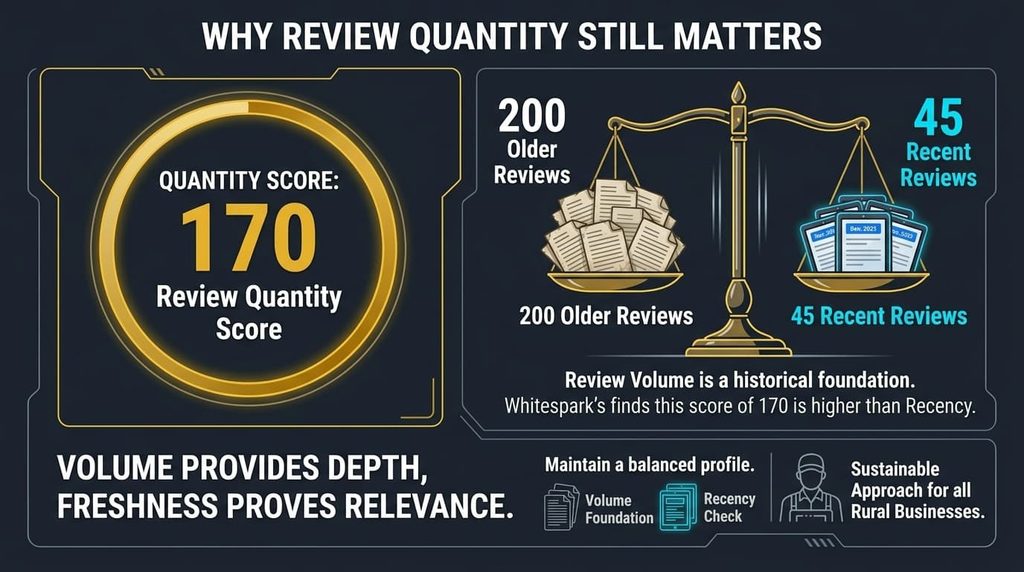
The score of 170 for review quantity remains higher than the recency score of 164 in Whitespark’s 2026 local pack and Maps rankings.
Review volume still matters because it gives potential customers more feedback to consider. A substantial review history can help people evaluate service quality, reliability, and customer experiences.
However, volume alone cannot show whether a business still delivers the same level of service.
How Should Businesses Balance Review Quantity and Freshness?
Rural businesses should build a review profile that reflects both their history and their current operations.
- Build volume: Request honest feedback from customers throughout the year.
- Maintain freshness: Avoid long periods without new reviews when customer activity continues.
- Encourage useful feedback: Make it easy for customers to describe their actual experiences.
- Monitor trends: Track ratings, new reviews, and recurring concerns.
A business with 200 older reviews may have a strong reputation history, while a competitor with 45 recent reviews may show more current customer activity. Neither profile automatically guarantees better Google Maps rankings.
The better approach is to maintain both a credible review history and a steady stream of new feedback. This also supports local reputation management and gives prospective customers more current information.
Why Has AI-Powered Local Discovery Reached 45%?

BrightLocal’s 2026 Local Consumer Review Survey reports that the share of consumers using generative AI for local business recommendations rose from 6% in 2025 to 45% in 2026. The survey identifies AI tools such as ChatGPT as a growing source of local recommendations.
This change suggests that local discovery is expanding beyond traditional search engines and review platforms. Customers can ask AI tools to compare businesses, identify suitable suppliers, or recommend services that meet specific needs.
For rural and regional businesses, this creates another reason to keep digital information accurate and useful.
What Should Rural Businesses Do About AI Discovery?
Businesses can prepare for AI-assisted discovery by improving their existing online presence.
- Keep business names, contact details, opening hours, and service descriptions accurate.
- Maintain a complete and current Google Business Profile.
- Explain the products and services offered, including the areas served.
- Publish useful website content that answers common customer questions.
- Collect genuine reviews that describe specific customer experiences.
- Build relevant local citations and links from trusted industry organisations.
For example, an agricultural contractor could publish a dedicated service page explaining its machinery, repair services, and coverage across surrounding towns. Clear information gives customers and search systems more context about the business.
The 45% figure should be interpreted within BrightLocal’s survey methodology. It describes reported consumer use of AI recommendations, not the share of all Australian consumers using AI or a direct ranking advantage for businesses that optimise their websites for AI.
Rural businesses do not need to develop their own AI systems to respond to this change. Improving existing website content, business listings, and review practices is a practical starting point.
What Does Google’s Declining Review Usage of 71% Mean?
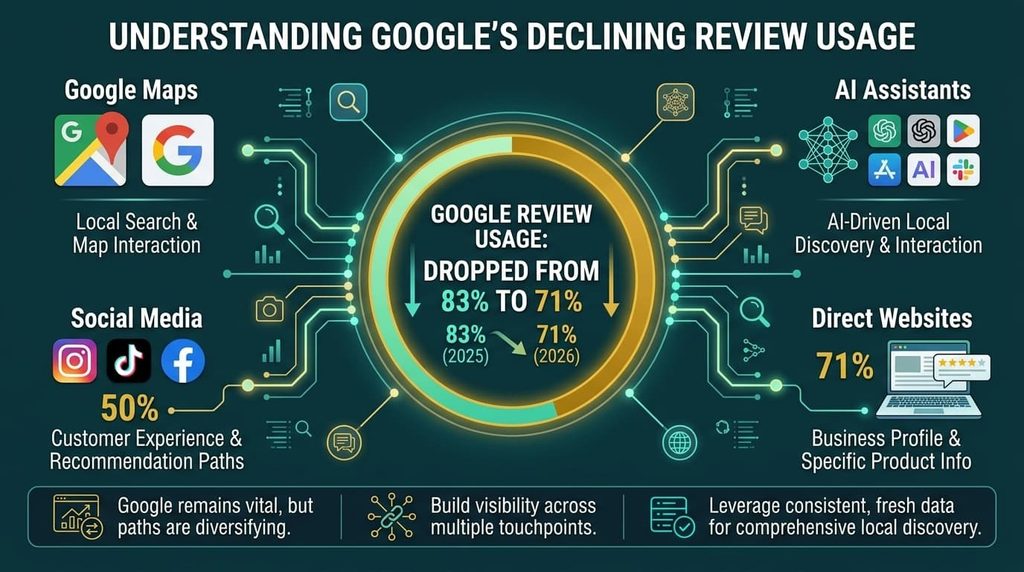
BrightLocal reports that Google review usage among surveyed consumers declined from 83% in 2025 to 71% in 2026. The survey also reports growing use of AI tools and other platforms for local recommendations.
Google remains a major source of local business information, but customers increasingly consult multiple channels. They may read reviews on Google, browse social media, visit a company’s website, or ask an AI assistant for recommendations.
This does not mean Google reviews have become unimportant. It means businesses should avoid relying on one platform to support their entire online reputation.
How Can Businesses Respond to This Shift?
A regional SEO strategy should help customers find consistent information wherever they search.
Businesses can start with these actions:
- Maintain accurate information across relevant directories and review platforms.
- Keep website content current and easy to navigate on mobile devices.
- Monitor customer feedback on the platforms that matter to their audience.
- Create location-specific service pages for important towns and communities.
- Track phone calls, enquiries, website visits, and leads to assess performance.
For instance, a rural accommodation provider might receive enquiries through Google Maps, social media, its website, and third-party travel platforms. Consistent details across those channels help customers understand its location, facilities, and booking options.
The important distinction is between review platform usage and search ranking factors. A decline in the share of consumers using Google reviews does not prove that Google reviews have less influence on Google Maps rankings.
Businesses should maintain a strong Google presence while ensuring that useful information is available across other relevant channels.
Why Is Regional SME AI Adoption Only 16%, Compared With 30% in Metro Areas?
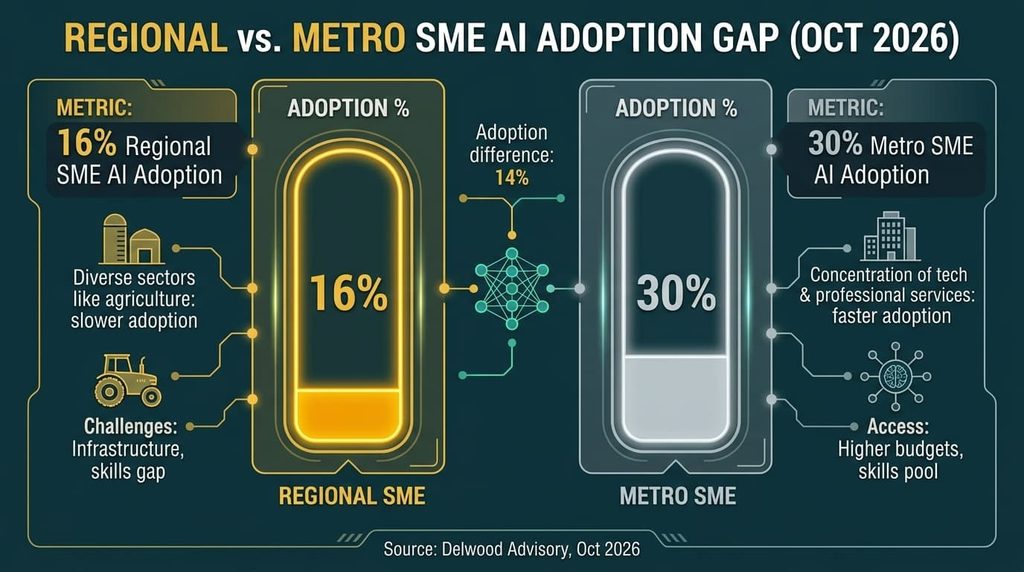
Research from Delwood Advisory, supported by Employment Hero, Google, Deputy, and the Tech Council of Australia, reports that AI adoption among regional Australian SMEs stands at 16%, compared with 30% in metropolitan centres. Employment Hero published these findings on October 22, 2026.
This gap suggests that regional businesses are adopting AI at a slower rate than their metropolitan counterparts. However, the figures alone do not establish why the difference exists.
Rural businesses may have different staffing levels, technology needs, infrastructure, and marketing priorities. Some may also see AI as irrelevant to their daily operations.
Yet local search is directly relevant to businesses that depend on customers finding their products and services across large geographic areas.
What Could Help Regional Businesses Get Started?
A business does not need an advanced technology strategy to improve its digital marketing.
- Identify repetitive marketing tasks that consume time.
- Improve existing website content and business listings.
- Establish a consistent process for requesting and responding to reviews.
- Use suitable tools to organise customer enquiries or draft routine content.
- Measure whether these changes save time or generate qualified leads.
Review management is a practical starting point because it builds on existing customer interactions. A business can begin by asking for genuine feedback and responding to customers without making a major technology investment.
The priority should be solving a real business problem. Regional businesses can adopt new tools gradually as their needs, budgets, and skills develop.
Why Are Fewer Than 30% of Agriculture Businesses Adopting AI?
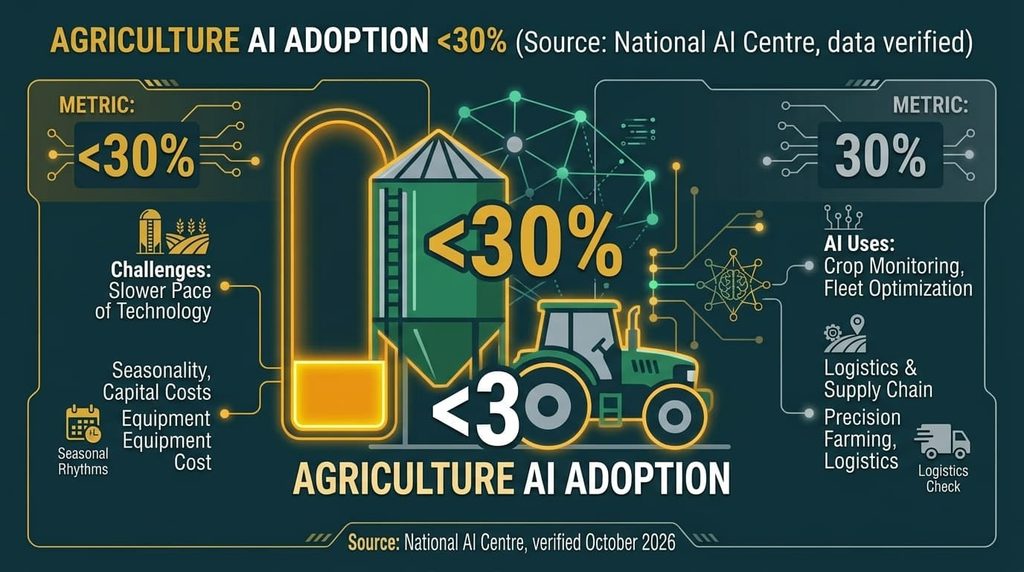
The supplied data pack reports that fewer than 30% of agriculture businesses have adopted AI, citing the National AI Centre. This suggests that adoption remains limited in the agricultural sector, although the exact figure and original report should be verified before publication.
Agriculture businesses often focus on production, machinery, logistics, seasonal work, and customer relationships. Digital marketing can compete with these responsibilities for time and resources.
However, local search remains relevant when customers look for agricultural suppliers, machinery repairs, farm contractors, rural accommodation, and specialist services.
Where Can AI Support Agricultural Businesses?
AI tools can assist with routine marketing tasks when businesses review their output and confirm that it is accurate.
Examples include:
- Drafting answers to common customer questions.
- Organising website content about products, services, and locations.
- Preparing initial drafts of social media posts.
- Summarising customer feedback to identify recurring concerns.
- Planning content around seasonal products, services, and events.
These uses can reduce administrative work without replacing agricultural expertise or human judgement.
Consider a farm equipment supplier serving several regional towns. It could use a simple content plan to answer common questions about equipment availability, maintenance, delivery areas, and seasonal purchasing needs.
The first-mover opportunity is practical, not guaranteed. Businesses that improve their online information and customer reputation may be better prepared for changing discovery habits. Low AI adoption across an industry does not automatically give an individual business a ranking advantage.
Why Do 93% of Consumers Read Reviews Before Visiting Local Businesses?
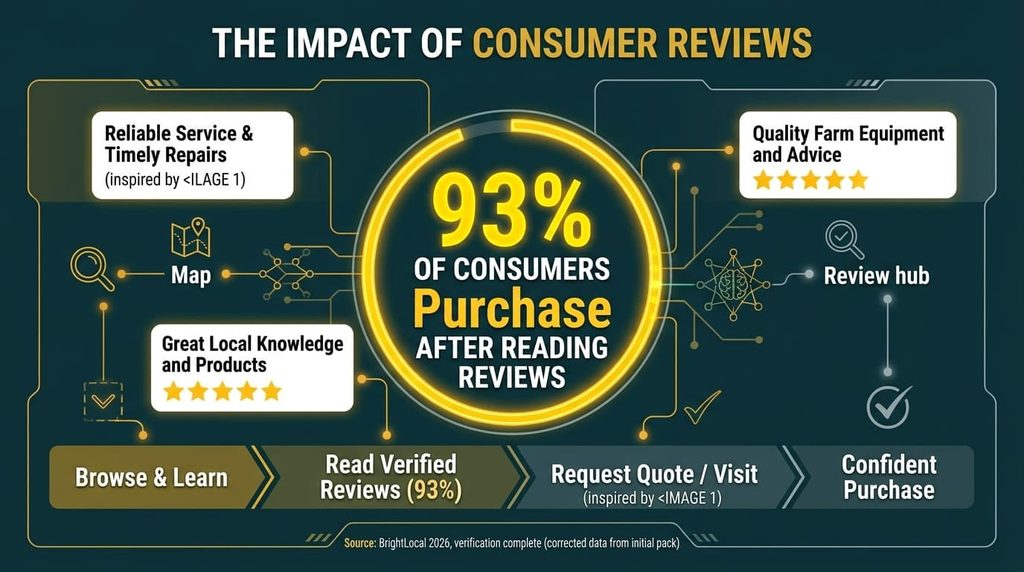
The supplied data pack attributes a 93% figure to consumers reading reviews before visiting a local business. However, BrightLocal’s published 2026 survey uses 93% for a different finding: consumers who have made a purchase after reading reviews.
The exact claim that 93% of consumers read reviews before visiting a business should therefore be checked against its original source before publication.
Even without that particular figure, BrightLocal’s research supports the broader point that online reviews influence how consumers evaluate local businesses.
Reviews can help customers assess reliability, service quality, and whether a business meets their needs. They can also provide details that a business’s own marketing content may not cover.
How Can Rural Businesses Make Reviews More Useful?
Businesses can encourage customers to share honest feedback and use that information to improve their services.
- Invite customers to describe their actual experiences.
- Respond professionally to positive and negative reviews.
- Address recurring complaints through service improvements.
- Avoid fake reviews and misleading customer claims.
- Monitor review themes to identify strengths worth explaining on the website.
For example, a regional farm equipment dealer might notice repeated praise for delivery reliability or concerns about repair turnaround times. These comments can help the business understand customer expectations and identify areas for improvement.
Reviews are not just a potential local ranking signal. They also help prospective customers decide whether to contact a business, request a quote, or make a purchase.
Why Do 81% of Consumers Expect Review Responses Within a Week?
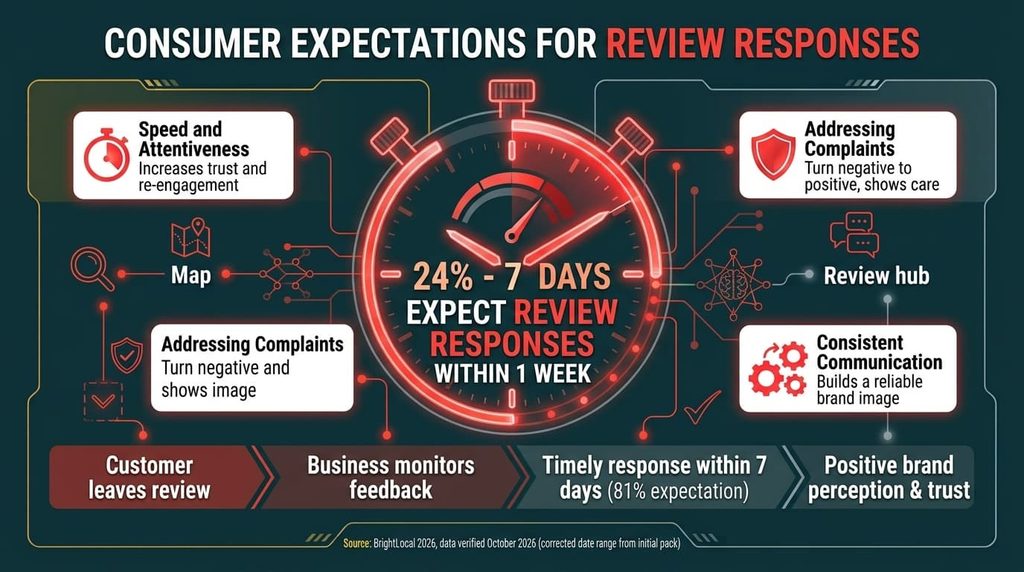
BrightLocal’s 2026 Local Consumer Review Survey reports that 81% of consumers expect a business to respond to reviews within a week. The research also indicates that some customers expect a response on the same day or by the following day.
A timely response shows that a business pays attention to customer feedback. It also gives the business an opportunity to address complaints and clarify misunderstandings.
For small rural businesses, responding to every review can feel like another task on an already full schedule. A simple process can make the work more manageable.
What Should a Review Response Process Include?
Businesses can use a regular schedule to monitor feedback and respond appropriately.
- Check important review platforms at least once a week.
- Thank customers for specific, positive feedback.
- Acknowledge legitimate complaints without becoming defensive.
- Offer an appropriate way to resolve sensitive issues privately.
- Discuss recurring complaints with the team responsible for the service.
A regional agricultural supplier, for example, could set aside time every Friday to review new customer feedback. This creates a predictable routine without requiring staff to monitor reviews constantly.
Responses should be genuine rather than generic. Businesses should also avoid disclosing personal or sensitive customer information in public replies.
The practical takeaway: Treat review responses as part of customer service, not simply as a way to improve local search rankings.
Why Do 31% of Consumers Only Use Businesses Rated 4.5 Stars or Higher?
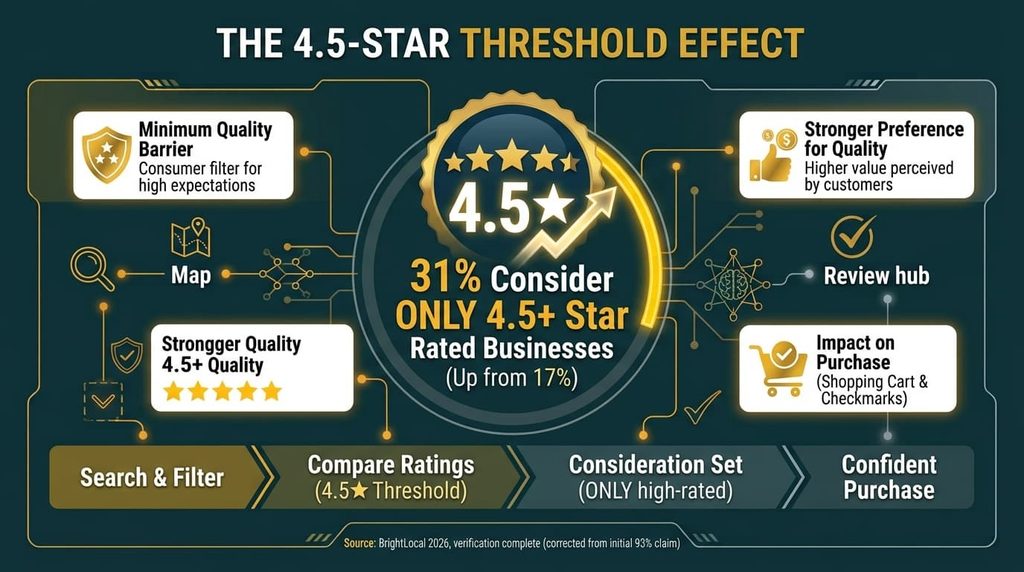
BrightLocal’s 2026 survey reports that 31% of consumers will only use businesses rated 4.5 stars or higher, up from 17% in the previous year’s survey. This suggests that some consumers use a minimum star rating when deciding which businesses to consider.
A high rating may encourage further research, while a lower rating may lead some customers to compare alternatives. However, ratings are only one part of the decision. Customers may also consider review details, service availability, location, price, and business reputation.
How Can Businesses Improve Their Review Profiles?
The best approach is to improve the customer experience rather than pursue a particular rating at any cost.
- Deliver consistent service and address the causes of complaints.
- Request honest feedback from eligible customers.
- Respond constructively to criticism.
- Monitor ratings alongside review volume and recency.
- Avoid buying reviews or pressuring customers to leave positive ratings.
A rural business should not manipulate its review profile to achieve a 4.5-star average. Genuine feedback provides more useful information and helps identify operational problems.
For businesses serving small communities, reputation can also extend beyond online platforms. Local recommendations, repeat customers, industry relationships, and community involvement can support trust alongside digital reviews.
The goal is to build a reliable reputation that reflects real customer experiences. Ratings can influence customer choices, but they should be part of a broader approach to customer service and local reputation management.
How Can Rural Businesses Turn Review Data Into a Local SEO Strategy?
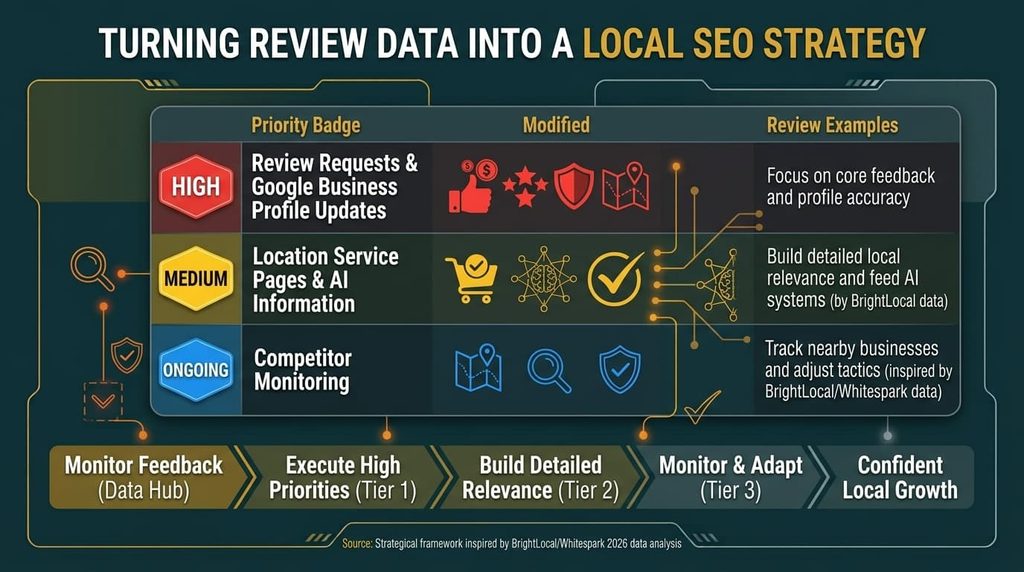
Rural businesses can turn these findings into a practical local SEO plan by combining consistent review management, accurate business information, and useful location-specific website content.
The supplied Whitespark scores place review quantity, recency, and sustained review growth close together. BrightLocal’s consumer research also points to changing discovery habits and growing expectations for recent reviews and timely responses.
Businesses should use the findings as strategic guidance rather than guaranteed ranking rules.
Which Actions Should Businesses Prioritise?
The following table outlines a practical starting point for small businesses, agricultural suppliers, and regional service providers.
| Priority | Action | How to measure progress |
| High | Request genuine reviews consistently | New reviews received each month |
| High | Respond to customer feedback | Response time and issue resolution |
| High | Update business listings | Accuracy of contact details and opening hours |
| High | Improve Google Business Profile information | Profile completeness and relevant customer actions |
| Medium | Create location-specific service pages | Qualified enquiries from target locations |
| Medium | Publish useful local content | Relevant organic traffic and engagement |
| Medium | Improve information for AI-assisted discovery | Referral traffic and tracked leads where measurable |
| Ongoing | Review local competitors | Changes in services, reputation, and local visibility |
These activities work best when they support one another. Reviews can strengthen customer confidence, while clear service pages explain what a business offers and where it operates.
How Should Businesses Target Nearby Towns?
A regional SEO strategy should reflect the actual areas a business serves. Businesses should avoid creating large numbers of nearly identical pages simply to target different locations.
Instead, they can build useful location-specific service pages that explain:
- Which products or services are available in each town.
- Whether delivery or on-site service is offered.
- How customers can request a quote or make an enquiry.
- What local customers need to know before purchasing.
- Which nearby communities fall within the genuine service area.
For example, an agricultural contractor serving three regional towns could create one main service page and additional location pages where the information genuinely differs. Each page should answer local customer questions rather than repeat the same keywords.
This approach supports nearby town keyword targeting, local search visibility, and local lead generation without relying on keyword stuffing.
What Should Businesses Avoid?
Businesses should protect their reputation and focus on sustainable improvements.
- Do not buy or fabricate reviews.
- Do not offer rewards in exchange for positive ratings.
- Do not assume that one ranking score guarantees a higher position.
- Do not treat AI adoption figures as proof of local ranking outcomes.
- Do not measure success by review count alone.
- Do not create misleading location pages for places the business does not genuinely serve.
A useful local SEO audit should consider customer reviews, Google Business Profile accuracy, website performance, location relevance, local citations, and conversions.
Businesses can then review their results over time and adjust their strategy based on genuine customer behaviour.
FAQ
How Can Rural Businesses Improve Local Search Visibility Across Multiple Towns?
Rural businesses can improve local search visibility by using a regional SEO strategy that targets nearby towns, counties, and service areas. Use local keyword research to identify service plus location keywords and low-competition local keywords.
Create location-specific service pages that explain which services you offer, where you operate, and how customers in surrounding communities can contact your business.
How Can Businesses Improve Google Maps Rankings in Rural Areas?
Businesses can improve Google Maps rankings by completing their Google Business Profile, selecting accurate business categories, and keeping their name, address, and phone number consistent across online listings.
Encourage satisfied customers to leave genuine reviews and respond to feedback promptly. Accurate local citations, relevant directory listings, and up-to-date service information can strengthen your business’s credibility and support better local pack rankings.
Should Rural Businesses Create Separate Landing Pages for Every Town They Serve?
Rural businesses should create separate local landing pages when they provide relevant services in different towns. Each page should describe the services available in that location, address local customer needs, and provide accurate contact information.
A regional hub-and-spoke SEO structure can connect individual town pages to a central service page. Avoid duplicate content that changes only the town name.
How Can Small-Town Businesses Find Local Keywords With Less Competition?
Small-town businesses can use local keyword research to identify long-tail keywords that match specific customer needs. Combine service names with town, county, and nearby location terms.
Review local search intent, seasonal search trends, and competing websites to identify opportunities. Nearby town keyword targeting can help businesses reach potential customers who search for services outside their immediate location.
What Should Rural Businesses Check During a Local SEO Audit?
A local SEO audit should review Google Business Profile details, name, address, and phone number consistency, local landing pages, mobile performance, and contact options. Check Google Search Console to identify queries that bring visitors to your website.
Test click-to-call buttons, page loading speed, and contact forms on mobile devices. These checks help identify problems that prevent nearby customers from finding or contacting your business.
What Should Rural Businesses Remember About Review Recency?
Recent reviews can help rural businesses build trust, but review recency alone won’t guarantee better local rankings. Whitespark’s 2026 survey scored review quantity at 170 and recency at 164, showing that both deserve attention.
Focus on getting genuine customer reviews regularly and keeping your business information accurate. Farm Table offers digital marketing support, including its local SEO services, which may help rural businesses improve their local visibility. Clear website content and consistent review management give your business a practical starting point as search habits change.